How Companies Use Stablecoins to Control Payments, Capital and Financial Infrastructure
Stablecoins are often framed as a technical feature of crypto products. In reality, in the European Union they represent something fundamentally different: a new form of financial infrastructure that companies can integrate directly into their business models.
With the introduction of MiCA (Markets in Crypto-Assets Regulation), stablecoins are now clearly defined and regulated. But from a business perspective, regulation is not the most important part. The real question is: why would a company build or use a stablecoin at all?
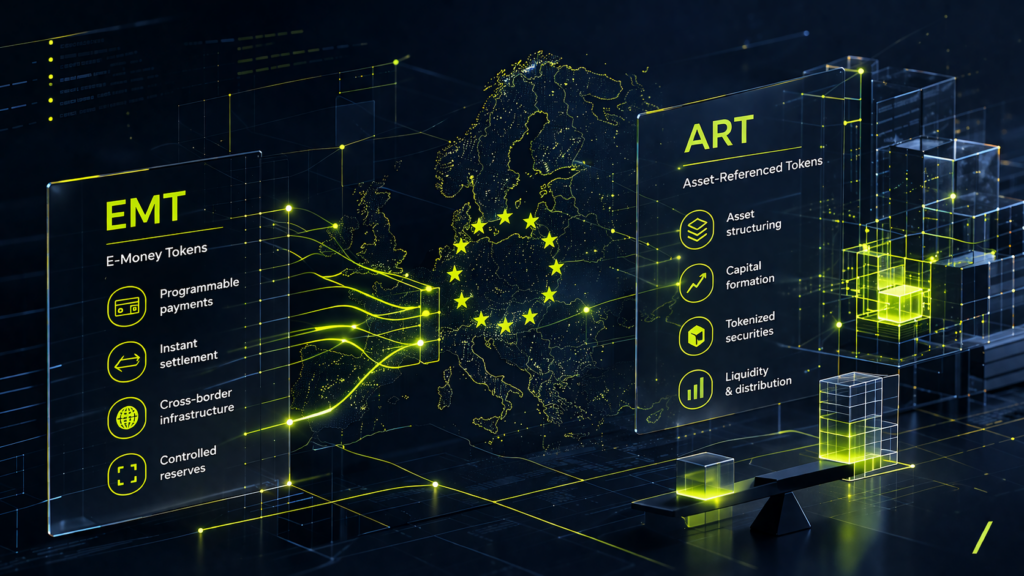
To answer that, it is critical to understand that in the EU there are two very different types of stablecoins:
- E-Money Tokens (EMT) — fiat-backed digital money (e.g. EUR or USD-pegged)
- Asset-Referenced Tokens (ART) — tokens backed by a basket of assets or structured value
They are often grouped together, but from a business standpoint they solve completely different problems.
At VoltLegal, we advise EU businesses on structuring stablecoin operations under MiCA — including EMI licensing for EMT issuers and MiCA CASP authorisation for businesses providing crypto-asset services..
EMT (E-Money Tokens): Turning Payments Into Your Own Infrastructure
An EMT is not just a digital version of money. It is a way for a company to take control over how money flows inside its ecosystem.
In a traditional setup, every transaction depends on multiple intermediaries: payment service providers, banks, card networks, settlement systems. Each layer introduces cost, delay and dependency. An EMT changes this structure. It allows a company to create a controlled financial environment where transactions can move instantly and according to its own logic.
This is why EMT is best understood not as a token, but as a private payment layer embedded into a business model.
Companies that implement EMT typically do it for a combination of reasons. First, it allows them to significantly reduce reliance on external payment infrastructure. Instead of routing every transaction through third parties, they can manage flows internally and settle transactions much faster, especially in cross-border scenarios.
Second, EMT enables something traditional finance does not: programmable money. Payments can be automated, restricted, conditional or tied to specific events. This becomes particularly valuable for platforms, marketplaces, fintech products or any system where transactions are part of the core logic.
However, the most underestimated aspect is the economic model behind EMT. The real value is not transaction fees, but control over reserves. When users hold funds in the system, the issuer manages the underlying reserves. At scale, this creates a significant financial layer that resembles the business model of major stablecoin issuers and, to some extent, traditional financial institutions.
Finally, EMT creates ecosystem lock-in. Once users operate within a controlled payment environment, they are less dependent on external systems. This increases retention, improves user experience and gives the company full control over how value moves inside the platform.
Because of this, EMT is not suitable for every business. It only makes sense where payments are central to the product. Fintech companies, neobanks, crypto platforms, marketplaces and high-volume transaction businesses are the most natural candidates. For companies without meaningful payment flows, launching an EMT is usually an overengineered solution with no real economic upside.
ART (Asset-Referenced Tokens): Structuring and Distributing Value
While EMT is about payments, ART operates in a completely different space. It is not designed to move money, but to represent value.
An ART is essentially a structured financial instrument in token form. It can be linked to real estate, commodities, funds, revenue streams or other underlying assets. This makes it closer to investment products than to payment systems.
From a business perspective, ART is primarily used for capital formation and financial structuring. It allows companies to rethink how assets are packaged, distributed and accessed by investors.
One of the most attractive features is fractionalization. Large, traditionally illiquid assets can be divided into smaller units, making them accessible to a broader audience. In theory, this increases market participation and lowers entry barriers.
Another frequently cited advantage is liquidity. Tokenization creates the possibility of secondary markets where ownership can be transferred more easily than in traditional structures. However, this is often overstated. Liquidity does not appear automatically — it depends on demand, trust and market infrastructure.
ART also enables new types of financial products. Revenue-sharing models, yield-generating instruments and hybrid structures become easier to design when value is tokenized. This opens the door to more flexible investment models, especially in private markets.
At the same time, companies often assume that tokenization allows them to bypass traditional financial regulation. In the EU, this is rarely the case. Many ART structures fall within existing frameworks such as MiFID II, AIFMD or the Prospectus Regulation. As a result, tokenization does not eliminate complexity — it often shifts it into a different legal and regulatory layer.
For this reason, ART is most relevant for businesses that already operate with assets or capital structures. Asset managers, real estate developers, private equity projects and infrastructure ventures are typical examples. For companies without a clear underlying asset or economic model, ART tends to become a conceptual idea rather than a viable product.
EMT vs ART: A Strategic Choice, Not a Technical One
One of the most common mistakes is treating EMT and ART as interchangeable tools. In reality, they serve entirely different strategic purposes.
EMT is about controlling the movement of money. ART is about controlling how value is structured and distributed.
If a company needs to optimise payments, reduce friction and build a financial layer into its product, EMT is the relevant direction. If the goal is to raise capital, structure investment exposure or tokenize assets, ART becomes the appropriate model.
Confusing these two leads to weak product design and regulatory issues later on.
What Companies Overlook When Entering the Stablecoin Space
Despite the growing interest in stablecoins in Europe, most companies underestimate several critical factors at the early stage.
The first is distribution. Creating a token is technically straightforward. Creating demand, usage and real economic activity around it is significantly harder. Without a clear distribution strategy, even the most well-structured model will not gain traction.
The second is the assumption that tokenization simplifies regulation. In practice, especially in the EU, it often leads to additional layers of compliance. This is particularly visible in ART structures, where financial regulation remains fully applicable.
Another overlooked point is infrastructure. In the case of EMT, a token without real payment flows has no meaningful function. The business case only works when the token is deeply integrated into how the product operates.
Liquidity is another area where expectations are often unrealistic. Tokenization can enable liquidity, but it does not guarantee it. Markets need participants, volume and trust — none of which are created automatically by issuing a token.
Finally, even the most advanced token structures remain dependent on traditional financial systems. Banking relationships, custody arrangements and regulatory positioning continue to play a central role in whether a project succeeds or fails.
Why Stablecoins Are Becoming a Strategic Advantage
Stablecoins in the EU are no longer an experimental concept. They are becoming a foundational element of how modern financial products are built.
Companies that approach them correctly are not simply adding a “crypto feature.” They are redesigning how money and value function inside their business.
EMT allows companies to internalise payments and build their own financial layer. ART allows them to rethink how assets and capital are structured and distributed.
Both require careful design, not only from a technical perspective, but from a legal and strategic standpoint.
How VoltLegal Supports Stablecoin and Tokenization Projects
At VoltLegal, we work with founders, fintech companies and operators who are building products at the intersection of regulation and financial infrastructure.
This includes:
- structuring EMT and ART models under MiCA
- assessing whether a token qualifies as e-money, asset-referenced token or financial instrument
- designing regulatory architecture that works in practice, not only on paper
- preparing projects for licensing, partnerships with EMI/banks and long-term scalability
If you are considering launching a stablecoin, integrating one into your product, or tokenizing assets, the key question is not whether it is possible.
The real question is:
what role it will play in your business model — and whether it creates a real advantage
If this is relevant to your business, you can reach out to discuss your specific setup.